Classical register1011
Quantum state\[\lvert 0 \rangle\]
Measurement\[P(0)=1.00\]
Quantum computers from scratch
Explore how a classical processor moves definite bits, how a quantum processor evolves amplitudes, why measurement is probabilistic, and how hardware turns fragile quantum states into usable computation.
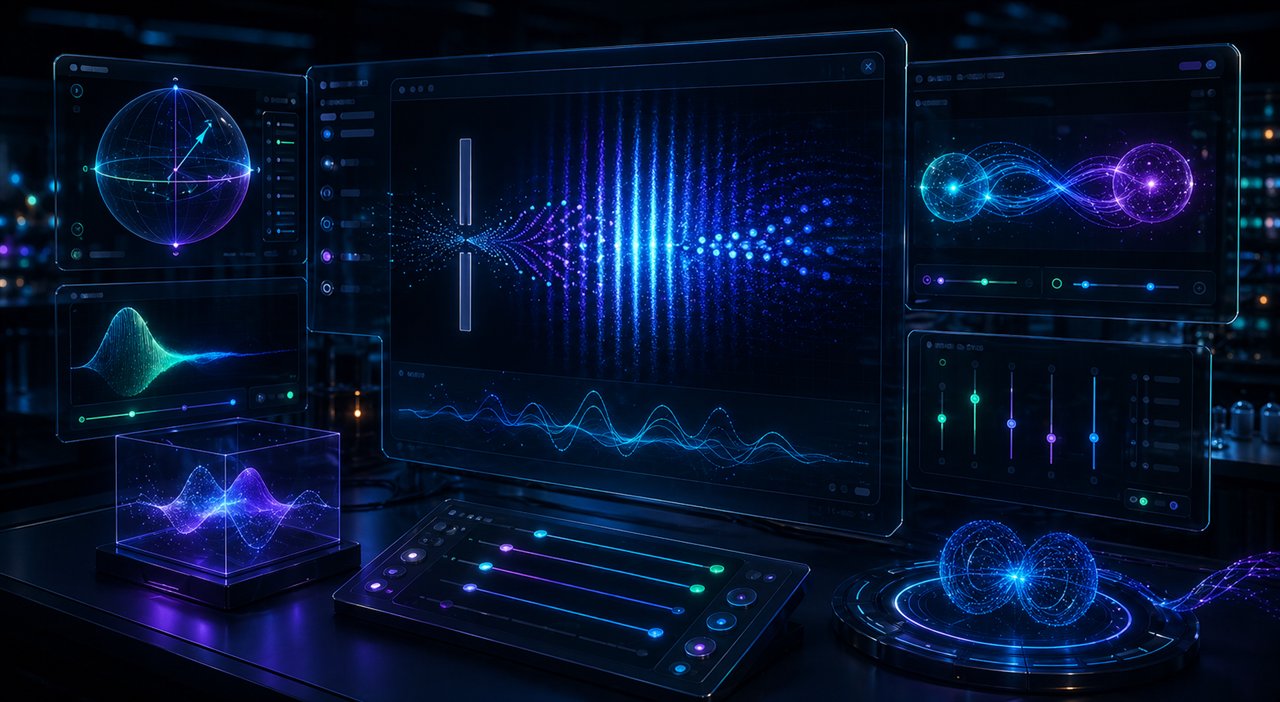
Interactive 3D-style simulator
The canvas shows classical transistor lanes on the left and a quantum circuit, Bloch sphere, cryostat, amplitudes, and measurement histogram on the right.
Normal computer
A normal computer stores information as bits, physically represented by stable voltage levels or magnetic states. Logic gates like AND, OR, NOT, and XOR transform definite binary values through transistor networks. Every step has a definite intermediate value.
Quantum computer
A quantum computer stores information in qubits. A qubit can be in a superposition with complex amplitudes. Quantum gates rotate the state vector without measuring it; useful algorithms arrange interference so wrong answers cancel and useful answers become more likely.
Measurement
Measurement converts amplitudes into a classical result. A quantum algorithm is designed so repeated measurements reveal the answer statistically.
Quantum gate library
Use the simulator gate selector above while reading these gate notes. The canvas updates the Bloch vector, amplitude bars, and circuit animation.
Acts like a quantum NOT by swapping the computational basis states and rotating the Bloch vector around the x-axis.
Creates equal superposition from a basis state. It is the doorway to interference and many algorithms.
Change relative phase. Phase is invisible in a direct basis measurement until later gates convert it into measurable interference.
A two-qubit entangling gate. It flips the target qubit when the control qubit is in the active basis state and can create Bell states.
Not a unitary gate. It samples the state and collapses it to a classical bit, so circuits usually measure at the end.
Logical qubits are built from many physical qubits. Syndrome measurements detect errors without directly reading the protected quantum information.
Real hardware stack
Building a quantum computer requires physics, microwave/laser control, cryogenics or vacuum, calibration, software, and error management.
Superconducting circuits, trapped ions, neutral atoms, photonics, spins, and topological approaches each trade speed, connectivity, coherence, and manufacturing complexity.
Qubits must be protected from uncontrolled environmental coupling. Superconducting processors use dilution refrigerators; ion and atom systems use vacuum, lasers, and electromagnetic traps.
Precisely shaped pulses implement rotations and two-qubit interactions. Calibration tunes frequencies, pulse amplitudes, timing, crosstalk, and readout thresholds.
Algorithms are translated into hardware-native gates, respecting qubit connectivity and device noise. The compiler inserts swaps, optimizes depth, and schedules operations.
A quantum program usually runs many times. The result is a distribution over bitstrings, which is then post-processed by classical software.
Fault-tolerant machines need logical qubits, surface-code-like protection, fast feedback, and high-fidelity gates across large arrays.
Continue learning
Study Hilbert space, measurement, spin, entanglement, and decoherence, then return here to see how those concepts become a working processor.