Wavefunction and probability
The wavefunction is a complex probability amplitude. The measurable probability density is \[|\psi(x)|^2\] after normalization.
Interactive learning panels
Tweak the parameters and watch quantum behavior change.
These browser-native panels replace the old Java applet idea with modern canvas controls that work on desktop and mobile.
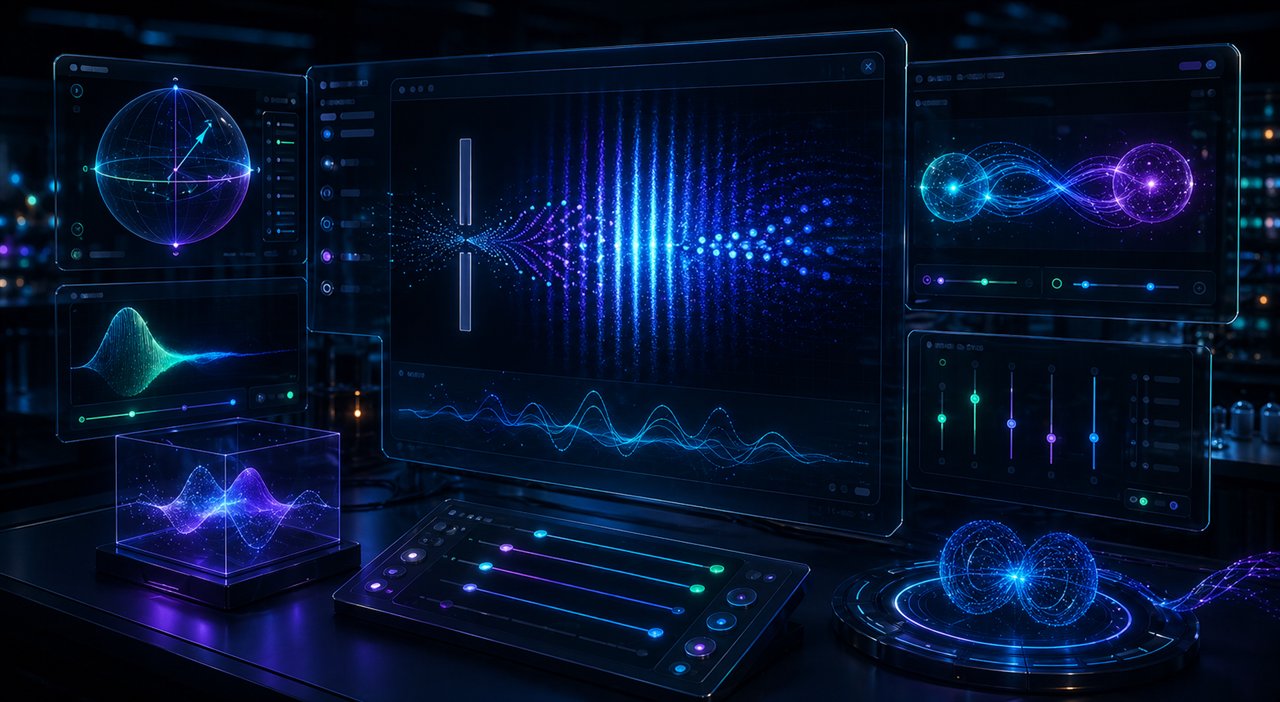
Animated concept theater
Watch the quantum idea before changing the math.
These animations explain the physical meaning first: states are amplitudes, observables are measured probabilistically, incompatible quantities create uncertainty, amplitudes interfere, barriers allow tunneling, and composite systems can become entangled.
Equation animation studio
Every core equation becomes a working visual model.
Each panel links a display equation to a live animation. Move the controls to see what the symbols mean physically: time evolution, energy eigenstates, probability, uncertainty, entanglement, and decoherence.
Time-dependent Schrodinger equation
\[i \hbar \frac{d}{dt} |\psi\rangle = \hat{H} |\psi\rangle\]
The Hamiltonian sets how quickly each component of the state rotates in phase. Different energies shear the wave packet into new shapes.
Energy eigenvalue equation
\[\hat{H}\psi_n = E_n\psi_n\]
An eigenstate keeps its spatial shape while only its phase evolves. In a box, higher quantum number means more nodes and larger energy.
Born rule
\[P(a_n)=|\langle a_n|\psi\rangle|^2\]
The projection amplitude can be positive, negative, or complex, but the observed frequency comes from its squared magnitude.
Commutator uncertainty
\[\Delta x\,\Delta p \geq \frac{\hbar}{2}\]
Compressing a packet in position requires many wavelengths, so the momentum spread grows. The sliders show the tradeoff, not measurement error.
Bell-state entanglement
\[|\Phi^+\rangle=\frac{|00\rangle+|11\rangle}{\sqrt{2}}\]
The state describes the pair as one object. Analyzer angle changes the correlation curve, not a hidden instruction carried by each particle.
Density matrix and decoherence
\[\rho=\sum_i p_i |\psi_i\rangle\langle\psi_i|\]
Diagonal entries are populations. Off-diagonal entries carry phase coherence; environmental coupling makes those coherences fade.
Thought experiment animation
Schrodinger cat connects microscopic quantum decay to macroscopic measurement.
This panel shows the idea briefly and concretely: an atom can be modeled as a superposition of undecayed and decayed branches, while the detector and cat become entangled with those branches until observation or decoherence removes visible interference.
Sealed box superposition
Before measurement, amplitudes for undecayed/alive and decayed/triggered branches evolve together.
Superposition is controlled probability amplitude
Move the amplitude and phase controls. The bar chart shows measurement probability, while the wave trace reminds you that phase matters before measurement even when probabilities look similar.
\[\lvert \psi \rangle\]
\[P(0)\,/\,P(1)\]
Entanglement creates correlations no shared coin can mimic
Change analyzer angles and entanglement strength. A maximally entangled singlet-like pair gives angle-dependent correlations that can violate classical Bell limits in the right settings.
Correlation: 0
1. Unknown qubit
\[\lvert \psi \rangle\]
2. Alice measures
Choose Alice's two classical measurement bits. The state itself is not copied; the bits tell Bob how to correct his half of the entangled pair.
Classical bits sent: 00
3. Bob corrects
Bob applies I; output state matches the input after correction.
Teleportation consumes entanglement and requires classical communication, so it cannot send information faster than light.
Interference from probability amplitudes
Each slit contributes an amplitude. The screen brightness follows the squared magnitude of the sum, so phase difference creates bright and dark fringes.
Qubit state geometry
The Bloch sphere visualizes a pure two-level quantum state. Angles set the amplitudes and relative phase before measurement.
\[\lvert \psi \rangle\]
Barrier tunneling
A particle with energy below a barrier can still have nonzero transmission because its wavefunction decays through the classically forbidden region.
Uncertainty slider
Momentum spread estimate: 1.04
Bell CHSH score
CHSH S: 2.828
Single-qubit gate intuition
Output: equal superposition
Check what you just explored
Answer a few quick questions on superposition, measurement, and entanglement. Your score feeds the learning-progress dashboard on the home page.
Continue learning
Connect this lab run to the theory and tools.
Move from the animation to the matching equations, calculators, and research updates without leaving the learning flow.