Quarks and colour
Hadron spectra point to quark constituents, while colour resolves baryon statistics and restricts observable states to colour singlets.
From the 1995 QCD lectures
Explore colour charge, gluon fields, confinement, asymptotic freedom, jets, deep-inelastic scattering, and chiral symmetry with interactive controls.
Paper analysis
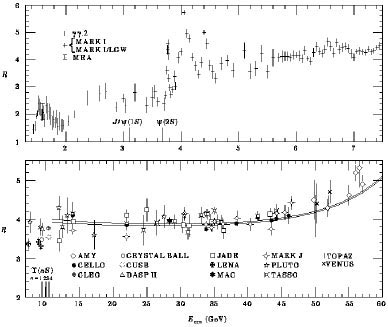
The PDF is A. Pich, Quantum Chromodynamics, hep-ph/9505231. It builds QCD from quarks and colour, introduces the SU(3) gauge Lagrangian, explains loop corrections and running coupling, then connects the theory to jets, DIS, \(\alpha_s\) measurements, and chiral symmetry.
Hadron spectra point to quark constituents, while colour resolves baryon statistics and restricts observable states to colour singlets.
QCD promotes colour rotations to local SU(3) symmetry. Eight gluons appear as gauge bosons, and unlike photons they also carry charge.
Loops make the strong coupling scale dependent. Gluon self-interaction drives asymptotic freedom at short distance.
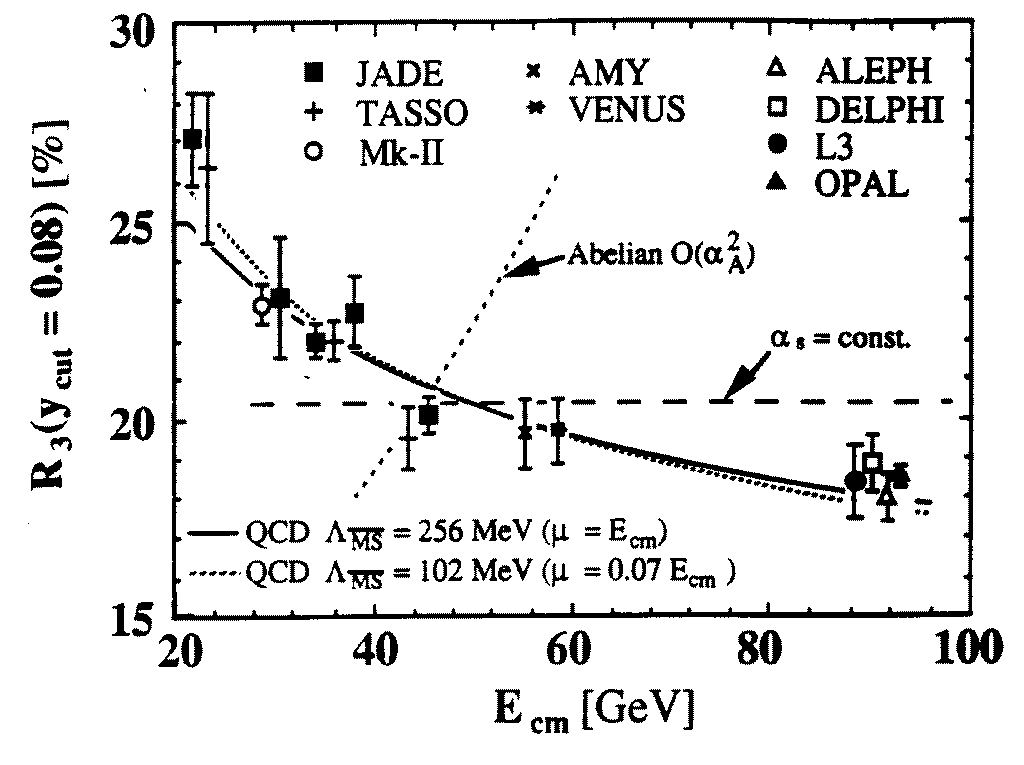
Jets, deep-inelastic scattering, event shapes, and \(R_3\) measurements test the non-Abelian structure and determine \(\alpha_s\).
3D QCD simulation
The 3D panel is a teaching model. At small separation, quarks behave nearly free because \(\alpha_s(Q)\) is smaller. At larger separation, the colour flux tube stores energy like a stretched string.
For QCD, the one-loop beta function is negative when \(n_f\leq16\). Increasing \(Q\) weakens \(\alpha_s\), which is the core of asymptotic freedom.
High-energy quarks and gluons appear as collimated sprays of hadrons. A hard gluon emission creates a three-jet topology, one of the classic QCD signals.
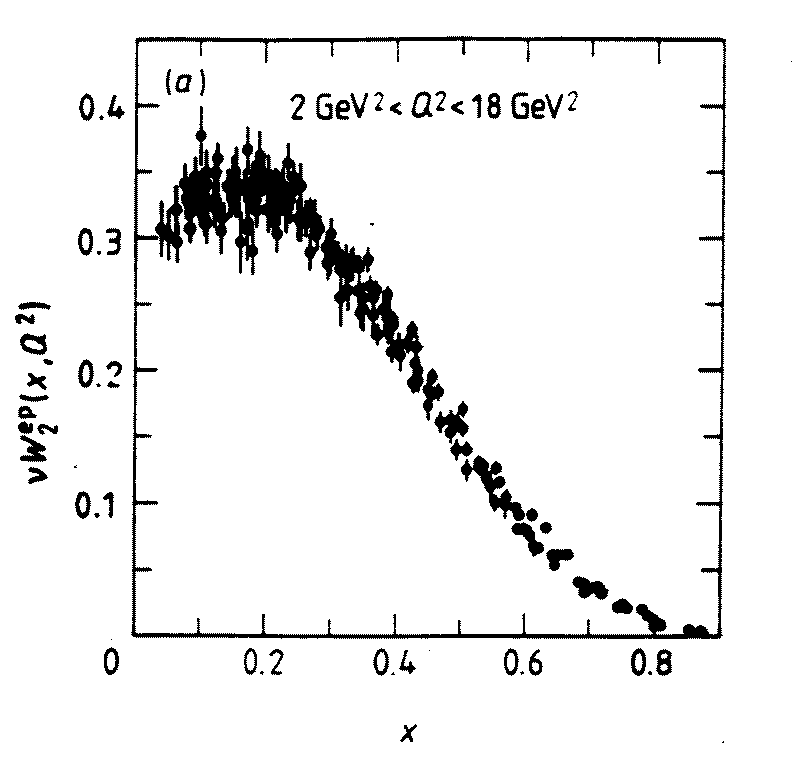
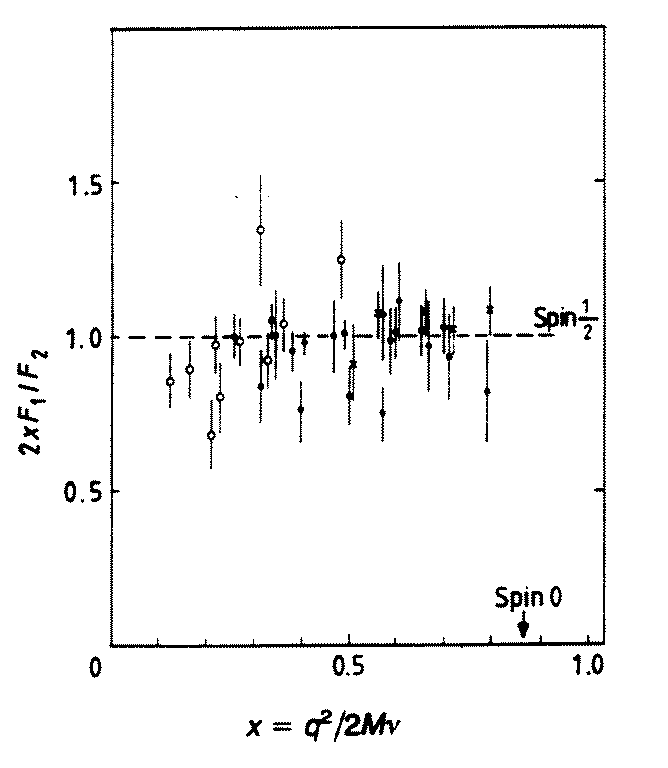
The structure functions probe quarks and gluons inside hadrons. Scaling violations reveal the QCD evolution of parton distributions.
Theory core
These are the minimal equations needed to connect the lecture notes to the interactive panels.
The covariant derivative contains gluon fields. The field strength \(G^a_{\mu\nu}\) includes gluon self-interaction terms because SU(3) is non-Abelian.
The coupling decreases logarithmically at large momentum transfer, so short-distance quark scattering can be treated perturbatively.
Confinement means isolated coloured quarks and gluons are not observed as free asymptotic particles; measured hadrons are colour neutral.
Images extracted from the PDF
The scanned figures are used as historical/experimental anchors while the canvases above provide the animated model.
Next steps
Use QCD beside the wave-function, atom, and quantum-lab pages to compare fundamental interactions, gauge fields, and measurement pictures.